
Assisted Dying Bill – How it fits into your course?
On the 29th November 2024, the UK House of Commons voted in favour of the Terminally Ill Adults (End of Life) Bill. The bill passed its Second Reading by a vote of 330-275, meaning that it will now go through a committee stage before a final reading of the bill. If successful at the final reading it will go before the House of Lords.
Provisions of the bill
The bill states that anybody wishing to end their life must fulfil the following criteria:
- They must be expected to die within 6 months.
- They must be over 18 years old.
- They must have the mental capacity to make the choice.
- They must make two separate declarations, witnesses and signed about their wish to die.
- Two independent doctors must determine that the meet the criteria to end their life.
The Terminally Ill Adults Bill is an important case study for all politics students. The following are ways in which it might fit into your course.
Private Members Bill
Firstly, the bill is an example of a Private Members Bill. The Labour MP, Kim Leadbeater won the Private Members Lottery back in July and decided to propose the legalisation of assisted dying in the UK. This is not the first time that such a major piece of legislation has been implemented via a Private Members Bill. For example, the following were all Private Members Bills:
- 1965 Abolition the death penalty in the UK
- 1967 Abortion Act – Legalised abortion in the UK for the first time
- 1967 Sexual Offences Act – Decriminalised homosexuality in the UK
All are pieces of legislation with huge social significance and issues with arouse strong feelings. It is because they spark so much debate that they are legislated for as Private Members Bills rather than by the government. The government know that if they put forward the legislation they might incur the wrath of a section of the public and as such it makes more sense to allow a backbench MP to propose them first.

Labour MP Kim Leadbeater used her Private Members Bill to propose the Terminally Ill Adults Bill. Kim Leadbeater ©House of Commons/Roger Harris
Collective Responsibility
The government suspended collective responsibility for the bill and said that it was a conscience vote, meaning that members of the government could vote which ever way they wanted without repercussions. For example, the Prime Minister, Keir Starmer voted for the bill, as did other cabinet members including the Chancellor Rachel Reeves. However, other members of the cabinet, including the Deputy Prime Minister Angela Rayner, the Foreign Secretary David Lammy and the Health Secretary Wes Streeting, all voted against it. Clearly, if the vote had been whipped, some key cabinet members may have decided to resign rather then vote in line with which ever position the government took. This would have destabilised the government and as such it made sense to make to suspend collective responsibility.
No formal whipping
As you can see from the graphic below (courtesy of the House of Commons) all parties were split on the bill. Currently, there are 402 Labour MPs. Of this number, 58% voted in favour whilst 36% voted against. The Conservative Party was somewhat less divided, with 19% voting in favour and 76% voting against.
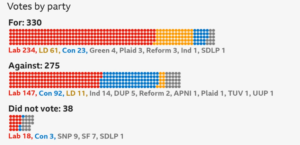
Courtesy of the House of Commons
Pressure Groups
The Terminally Ill Adults Bill is also a great case study for examining the role of pressure groups. Groups on both side of the debate were active in lobbying MPs and the public to put forward their view. Opposing the bill were groups such as Care Not Killing whilst those in favour include Dignity in Dying. Pressure groups on both sides have collected petitions, written letters to the Prime Minister and other MPs and focused on putting forward their arguments through the media.
The bill has shown the importance of having well known figures representing pressure groups. On the side of those wishing to legalise assisted dying, the television presented Dame Esther Rantzen, who has stage four lung cancer, was an active advocate, using her fame to gain media attention for the campaign. On the other side, famous faces including the actress and disabilities rights campaigner, Liz Carr, as well as the former Paralympian, Baroness Tanni Grey Thompson, opposed the law change. Famous figures are a considerable asset to pressure groups as they are able to gain valuable media attention.
Devolution
Currently, the Terminally ill Adults Bill will only apply in England and Wales. There is a separate bill going through the Scottish Parliament, which is similar to that in England. Northern Ireland will not be included in the Terminally Ill Adults Bill and at present there is no attempt to introduce a similar piece of legislation there. This is therefore a great example of how many matters are devolved to the respective Parliaments and the impact that this can have on citizens in each country.
The Parliamentary Process
All bills must pass through each stages of the legislative process by the end of the Parliamentary session on 25th April. Given that there is still some uncertainty around the bill this is going to be difficult, though doable. The bill must also make its way through the House of Lords in which it will face some significant scrutiny. As the bill was not in the governments manifesto, the Lords could choose to delay or block it. If this occurred then the government would have a serious decision to make about whether it decides to preserve with a bill on which it does not take an active position.
