Are party manifestos important?
Take a moment to study the chart below. It shows the change in polling numbers for each of the major political parties during each general election campaign of the last 60 years.

What stands out most is the consistency of the polls throughout each election campaign. This would suggest that very few events impact upon election campaigns once they have begun, and this would include the party manifestos which are usually published a few weeks into a campaign.
Though the chart does suggest that there is often a change in party support, most tellingly in 2019, this can be put down to voters showing dissatisfaction with the two major parties before coming to accept that they only a vote for either the Conservative and Labour Party are realistic options if they want to influence the final election outcome.
Manifestos have very little impact because what is contained in them is rarely a surprise. The parties tend to release key parts of their manifestos to the public way in advance of a general election, usually to test the public reaction to them. A good example of this came in recent years whereby the Labour Party committed to spending £28 billion a year on green energy. This will not now appear in the party’s 2024 manifesto following concerns of whether the country could afford to borrow more money to fund the plan. On the other hand, Labour’s commitment to charging VAT on private schools will appear in the manifesto as public support for the policy has held up well.
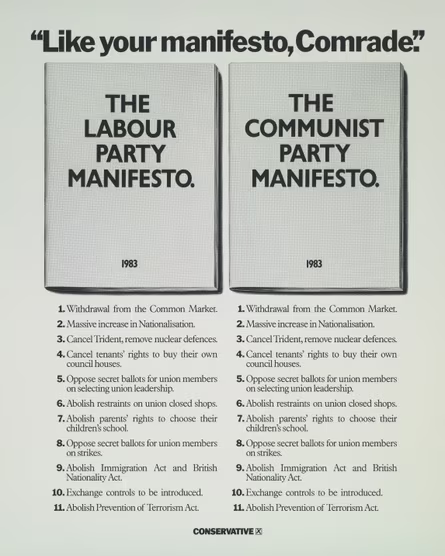
There are perhaps only two occasions where manifestos might be considered to be important in determining the vote share a party won in an election. The most infamous of these occurred in 1983 with the Labour Party’s radical left-wing manifesto, which the Labour MP, Gerald Kauffman, described as ‘the longest suicide note in history’. The manifesto committed the Labour Party to unilateral nuclear disarmament, leaving the EEC, abolition of the House of Lords and raising taxes on the richest. Coming just as Thatcher was profiting from victory in the Falklands Wars and with an economy that was beginning to improve following a long recession, Labour’s manifesto seemed too extreme for many. Moreover, as the chart indicates it appears to have seen Labour lose support to the SDP, who had only recently formed following a split in the Labour Party where members including David Steel and Roy Jenkins had left Labour to create a new, more centrist party.
The other interesting example came in 2017 when Theresa May’s Conservative Party lost a big lead in the polls to Jeremy Corbyn’s Labour Party. Here, uniquely, both party’s manifestos played a part. The Conservative manifesto proposed to solve the crisis in social care by making those with assets of over £100,000 pay for their social care needs in old age, and this would be achieved by people selling their homes after their deaths. There was also the inclusion of the removal of the winter fuel payments for the most well off pensions and a scrapping of the triple lock pension guarantee and replacing it with a double lock. The manifesto was received poorly by many and Theresa May had to backtrack on the social care policy. By this stage the damage was done however and May’s lacklustre campaign, which included failing to turn up for the leaders debate contributed to the decline in support for the Conservative Party.
What is peculiar is that the Labour Party’s manifesto is that it was almost as radical as the one in 1983 yet was much more popular. In 2017, Labour promised to renationalise the railways, abolish tuition fees, raise taxes on the top 5% of earners, lower the voting age to 16 and plant 1 million trees. So how could two very similar manifestos lead to such wildly different reactions? The answer is simply that they need to be place in the context of their time. What appeared radical and backwards in 1983 was seen as positively radical in 2017, by which point a large proportion of people were less favourable to privatisation for example. People were also much more comfortable with new radical solutions to Britain’s growing problems, following 7 years of austerity which had left many parts of the state in dire need of funding.
Are manifestos important? The simple answer is no, they merely confirm what most people already thought. Despite this, more radical manifestos, with surprising policy inclusions can make an impact, either positively or negatively.