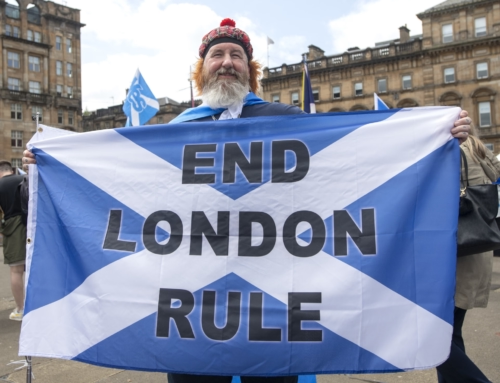
Evaluate the view that the Presidency is imperilled rather than imperial
First coined by Arthur Schlesinger in 1973, the term ‘imperial President’ was a label given to explain how the Presidency had grown in power, far beyond what had been laid out within the constitution. For Schlesinger, the President had seen an increase in their power, particularly in foreign policy and they had found themselves increasingly unchecked by the other branches and unaccountable for their actions. For many, Schlesinger was writing as a reaction to the Presidency of Richard Nixon rather than thinking more holistically about the office of President. Nixon himself called the imperial presidency thesis a ‘straw man’ by which he meant that people on the left had made him appear to be acting without constraints on his power so that they could paint him in a bad light and then burn him down. And burn him down they did. Nixon was forced to resign in 1974. Hardly an emperor. For this reason alone, it would be quite the stretch to label the President imperial.
Let’s take a look at how this might be discussed in an essay on the topic:
Paragraph 1 – The President is imperilled in Domestic Policy

The President is particularly imperilled in domestic policy. A President might be elected with a sizeable mandate of their own and then find that they are unable to enact the policies on which they have campaigned. President Biden provides a great case study here. In 2020, he campaigned on the slogan, ‘build back better’ and yet, despite the Democrats holding a majority in both houses of Congress, he was unable to pass the Build Back Better Bill, having to withdraw when it met with opposition from within his own party. Similarly, in President Trump’s first term he was unable to pass the American Health Care Act which would have repealed Obamacare, again, even though his Republican Party were in possession of both houses of Congress. The President’s consistent inability to pass their domestic legislation is hardly the sign of an emperor who does as they please and is therefore a clear sign that the Presidency is more imperilled than imperial. On the other hand, the President can invoke direct authority to bypass Congress. For example, after just one year in office, President Trump has signed 236 Executive Orders, granting him the power to make considerable changes without having to wait for Congressional approval. For example, he was able to use an executive order to enforce the Hyde Amendment, which states that federal funds could not be used for abortion services, whilst he also ended birthright citizenship, which means that just because you were born in the USA, does not mean you are ‘legally’ American and unable to be removed from the country. Nonetheless, executive orders are limited in scope. They only allow the President to direct the executive branch to carry out laws in a particular way rather than completely redefine the law itself. Moreover, they can be challenged by the Supreme Court and halted by Congress. For example, Barack Obama issued an executive order to close Guantanamo Bay in 2009. However, Congress denied him the funding to do so which meant that the prison facility still remained open, dashing a key pledge Obama himself had made when campaigning for the Presidency. With this in mind, it is clear to see that in reality, even the direct authority of the President is limited and they are far from imperial in domestic policy.
Paragraph 2 – The President is Imperial in Foreign Policy
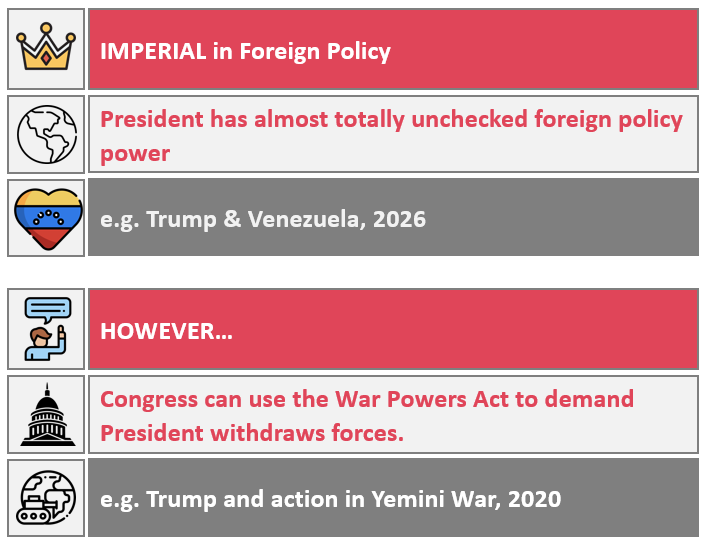
Given the President’s impotence in domestic policy it is common for them to seek to express their power in foreign policy. It is in the field of foreign policy that most Presidents can genuinely express their imperial tendencies. This was clearly the case for President Trump, who in January 2026, executed a regime change in Venezuela, abducting their President Maduro with very few questions asked. In fact, President Trump has used foreign policy to bolster his own image as well as his power. He has put considerable pressure on Europe to increase their contributions to NATO, has threatened to invade Greenland, is threating to take action against Iran and has helped to conclude seven wars, including seeking solutions to the Gazan and Ukrainian conflicts. This from a President who promised to withdraw from America’s foreign conflict. It has perhaps been the case that the President has realised that true unchecked power can only be found in the realms of foreign policy. This is not to say that the President has completely unchecked foreign policy powers however. For example, it is Congress to whom the Constitution gives the power to declare war. Moreover, Congress can invoke the War Powers Act which demands that the President withdraw American military personnel from a region within 60 days. This was the case in 2020 when Congress successfully voted to pass the War Powers Act, telling President Trump to remove his forces from the Yemeni War. Nonetheless, these checked have proved to be almost completely obsolete. The passage of the War Powers Act in 2020 was vetoed by President Trump and Congress did not have the sufficient votes to over-ride the veto. The same was true when Congress attempted to prohibit the use of troops in Venezuela and against Iran in 2025-2026. Once again, neither attempted use of the War Powers Resolution had the required number of votes to pass. As for Congress’ power to declare war. They have long since determined that this is not a power they want. In fact, the last declaration of war by Congress came in 1941. With this in mind, foreign policy is an area in which the President is imperial, with few checks against their power.
Paragraph 3 – The President faces limited scrutiny from Congress

The definition of an emperor is someone who is almost totally unaccountable for their actions. Is this true of the President? In many cases the President can find themselves safe from Congressional accountability. In his first term, President Trump faced impeachment charges on two occasions, however both times the Senate failed to find the two thirds majority needed to remove him from office, this despite the events of January 6th, 2021, when pro Trump supporters attacked Congress to prevent the certification of the 2020 election results. The current hyper partisanship that exists in Congress has severely damaged any notion of holding the president to account. Both parties have tendency to go lighter on Presidents from their own party with the Democrats asking few questions of President Biden during his term in office. The problem is exacerbated when the presidents party holds both houses of Congress, something that has become increasingly common in the first two years of their Presidency but then less common after. When this is the case, the President’s party has control over committees and can hold special select committee investigations into their actions. Nonetheless, no President is immune forever. Perhaps, the best example is the President of whom the imperial President thesis was written, Richard Nixon. Nixon acted as an imperial president, demonstrating huge unchecked powers, secrecy in foreign policy and a conspiratorial mindset, believing that the press and his ‘enemies’ were out to get him. Yet, even our most imperial President was forced to resign his office following the uncovering of the Watergate scandal, with both the Supreme Court and Congress holding him to account. Many have argued that President Trump acts in an imperial manner, but again this is a president who lost re-election in 2020, hardly imperial. Ultimately, no President is unaccountable for their actions. Even if Congress takes no action to restrain the President, then the Constitution provides a strait jacket by which even the most imperial of Presidents can be restrained. Moreover, the public will determine whether they believed a President to be acting imperially. Those that they believe to be acting as such are more often than not removed at subsequent elections. Imperial, not likely.