
Unit 1 – The Media: Evaluate the view that the media has little impact on voting behaviour
The media has come up before by I think that it is an interesting topic to revisit when revising, particularly given that we have the 2024 election as a case study.
Introduction:
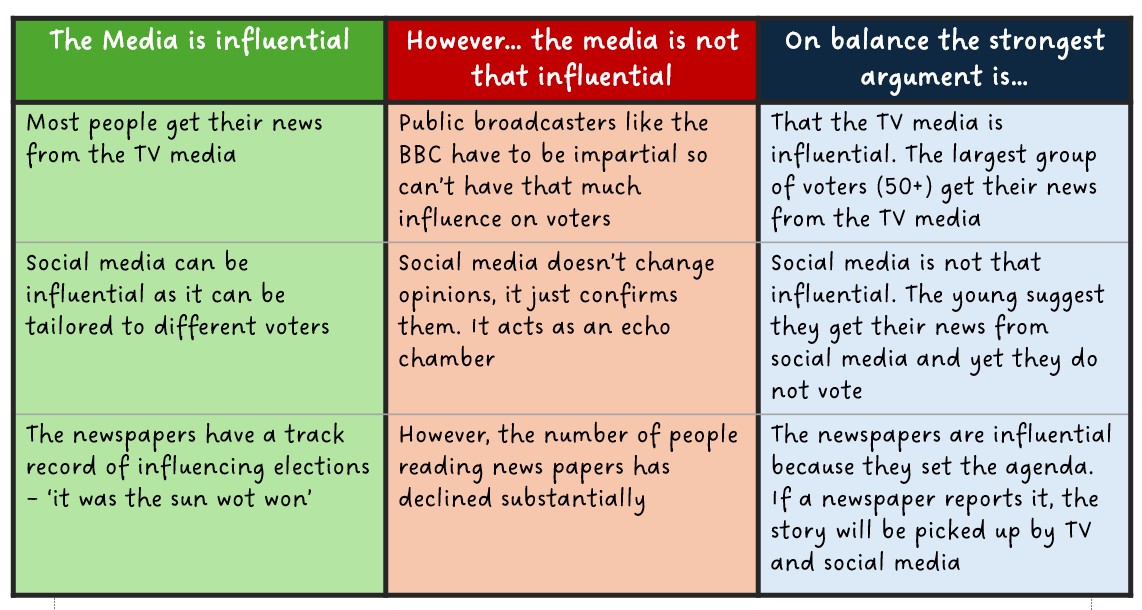
I think that the answer to this question is that media is influential. However, not in the way that we might necessarily think. The media just confirms what we already think rather than change any minds. In the introduction I would comment on the different forms of media, (newspapers, TV news and social media) and how each might be influential in its own way.
Is the news media influential?
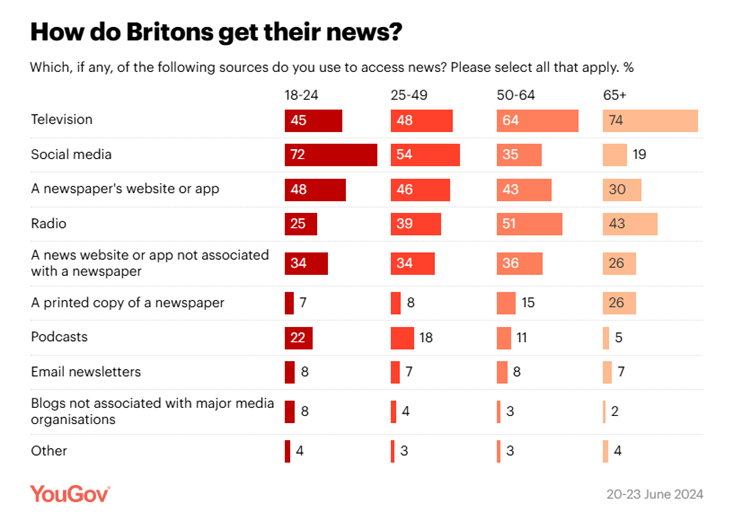
The first point to make is that the most popular way in which people in the UK get news is via TV news, 45% of people say it is their main source of news. This is closely followed by news websites of which 41% say this is how they get their news. In fact, during the 2024 UK election, 58% of people said that the TV was their main source of news about the campaign. Moreover, 49% of people in 2023 said that the BBC news was their main source of news. This is interesting because as a public broadcast the BBC has a duty towards impartiality and therefore cannot seek to influence but must present both sides of an arguments, hence why any statement by one party must be followed by a statement by the opposition. It is worth noting that the second most viewed source was ITV source, (34%) another public broadcaster with a duty towards impartiality. Therefore, it would be fair to say that the TV news media has a limited impact on elections because it just reports the news rather then attempting to change how the electorate think.

Voters continue to cite TV news as their main source of information about politics.
Nonetheless, the number of people saying that their main source of news is the BBC or ITV has been declining for a number of years. In fact, the number of people who say that the BBC new is their main source of news has been declining by about 4% every year. Therefore, it perhaps doesn’t have the impact that it did and certainly not the impact that it did before the turn of the century and the rise of the internet. On balance it is key to note that the news is important because of who it reaches. 74% of over 65s say that the television is their main source of news, compared to just 45% of 18–24-year-olds. This is important because we know that the turnout of the over 65s is way higher than that of 18-24s. Therefore, we can certainly argue the television has the biggest impact of all media sources because it reaches the most notable voting group. Moreover, although we have said that the impact of the news media is declining, public broadcasters (the BBC, ITV, Sky News and Channel 4) still make up for 5 of the 6 most popular sources of news for the public, with only facebook having similar levels of popularity.
Social Media
A second point to make is about the impact of social media. With each election we are told that this election will be fought on social media. This is increasingly true, but it doesn’t really tell us enough about the influence that social media has. The 2024 election demonstrated the growing influence of social media. For example, when asked where supporters of each political party got their news from, 51% of Labour voters got theirs from social media whereas just 27% of Conservative voters said that they got theirs from social media. This figure was dwarfed by the 43% of Lib Dem voters and 41% of Reform voters who said they got their news from social media. This is interesting because political party can use social media in a tailored way. They can target particularly groups of voters in particular constituencies and this might help to explain how both Reform and the Lib Dems were able to squeeze the Conservatives out in a particular number of constituencies. This is something that cannot be achieved using the TV or print media.
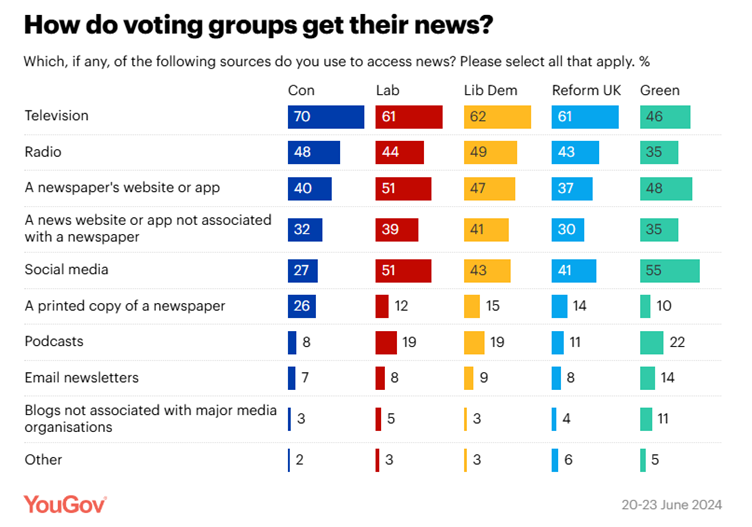
A YouGov poll showing where voters for each party got their news in 2024.
On the other hand, it must be argued that the impact of social media is limited because rarely does it change any opinions. People’s social media accounts will feed them with content that they are known to respond positively to. In that sense, social media is just an echo chamber and therefore is less influential, because it simply ensures that the most vociferous supporters of a political party will be more likely to vote for that party. There is also a point to be made about the disinformation of social media. In 2024, 77% of voters said that they had encountered disinformation relating to the UK election on social media and 70% said that disinformation was their biggest concern around the conduct of elections. Nonetheless, we might anticipate that the disinformation voters have said that they see relates to negative stories about ‘their side’ rather than voters being able to spot all the false stories that appear. Therefore, we should reiterate that many voters tend to believe what they want to believe and so what they are fed with by their social media accounts will change few views, but once again only entrench them further. On balance, I think that a good point to make is that the impact of social media is overrated. This is because the primary group who claim to use social media for political information is the 18-24 age group. The % of people reliant on social media for news then decreases significantly the older you get. At present we don’t have the exact turnout for each age group at the 2024 election but what we do know is that in the constituencies with the highest number of 18-24 year olds, had the lowest turnouts. Therefore, I think that it is fair to say that given that the one group who use social media to inform their political views have the lowest voter turnout, and tend to vote homogenously with left of centre, particularly either with Labour or the Greens, the impact of social media is over rated.
The final point to make is about the news/print media. There was a time when the newspapers were of massive influence in UK politics. In 1992, the Sun’s famous headline ‘If Kinnock wins today, can the last person to leave please turn out the lights’ was said to have decisively swung that election, so much so that the newspaper proclaimed, ‘It was the Sun Wot Won’. In more recent times we have seen the press’ negative depiction of Ed Miliband for failing to eat a bacon sandwich and that of Jeremy Corbyn as a terrorist sympathiser gain traction amongst the public. In fact, given that most of the UKs newspapers support the Conservative Party this could help to explain why the Conservative have spent 32 out of the last 45 years as the governing party in Britain. Moreover, given the degree to which party leaders appear desperate to curry favour with the media, look at how Starmer was happy to write articles for the Telegraph, the Times and the Sun, all anti Labour papers, suggests that politicians think that the print media is influential.
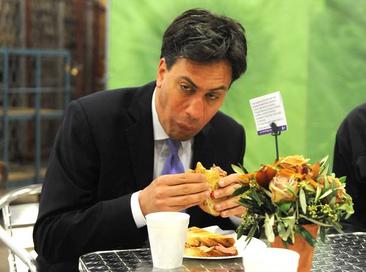
Ed Milliband pictured eating a bacon sandwich in 2015 fuelled the media’s negative depiction of the Labour leader.
Nonetheless, there is no doubt that the print media is on a massive decline. In fact, just 26% of the UK public say that they get their news from print media. This is a considerable decline from the 1980s and 1990s when the media was certainly more influential. Another point to make is that newspapers such as the Sun are probably not as influential as they think because their readers don’t simply vote as the newspaper tells them to. In fact, in 2017, only 54% of Sun readers said that they voted in line with the newspaper, which said their readers should vote Conservative. In fact, in 2011, the Sun’s owner, Rupert Murdoch said that his newspapers don’t influence how people vote, but that the paper merely reflects the public’s view. A great example of this came in 2024 when the Sun switched its allegiances, albeit quite begrudgingly to support Labour, having previously advocated for the Conservatives. Clearly, the Sun could see that Labour were going to win and wanted to back the winning side rather then try to tell people to vote Conservative. On balance I think that an important to make is that the print media may not be read very widely any longer, but this misses the point about its influence. The print media informs social and news media. If you are reading a story online, it is likely that that story was first broken and publishes by one of the leading UK newspapers. Look at how the party gate stories were first reported by the Daily Mirror. People most likely did not buy the Daily Mirror to read about party gate but they then heard about it thanks to their original publication. Similarly, in 2022 the Daily Mail ran 13 consecutive headlines about a curry that Keir Starmer had, supposedly breaking covid restriction. By running the story incessantly, the news media, and particularly the BBC felt that they had to pick up the story. Therefore, I would argue, perhaps counterintuitively that the print media is still massively influential in the UK.
Conclusion
Is the media influential? Absolutely it is. I think the smartest point to make here would be to go against the tide and argue that social media is perhaps the least influential of all, whereas the print media continues to set the news agenda whilst the TV news and our public broadcasts remain the biggest source of people’s news consumption.