
Essay Help – Evaluate the view that the system for nominating candidates for the Presidency is in need of reform.
One problem associated with the Presidential nomination procedure is that candidates are selected by only a small minority of the general public. The system of primaries and caucuses are problematic because they engage only a small number of political active individuals. In 2024, just 16.6million people voted in the Democratic Party primaries. This might be excusable given that at the time of the primaries, the incumbent Joe Biden was standing almost unopposed for the Democratic Party nomination. However, in the more contested Republican primaries, only 22.2 million Americans cast their ballot. It is therefore difficult to suggest that the best candidates are winning the race for their party’s nominations when so few people vote to select them. Moreover, given that turnout within the primaries tends to be of more ideological and engaged voters, there is a tendency for the more ideological extreme candidates to win the nomination ahead of more moderate candidates who might appeal to the electorate as a whole. This is only somewhat true however. Though Donald Trump might be considered more ideologically extreme and won the Republican Party nomination in 2016 and 2024, it has been conventional for more moderate candidates to prevail. For example, in 2016 Hillary Clinton defeated the more left-wing Bernie Sander to the Democrat nomination and in 2020, the establishment figure of Joe Biden defeated Sanders also. Nevertheless, despite their faults, the primaries and caucuses still provide a democratic way of selecting each party’s nominee. This is very different to the UK for example whereby the leaders of each party are selected by a small number of party members. In 2024, Keir Starmer became Prime Minister despite having been elected by 275,000 Labour Party members and then 19,000 people in his constituency of Holborn and St Pancreas. Therefore, whilst it is fair to say that the system of primaries and caucuses is far from perfect, they do at least provide a democratic route towards nominating candidates.
Another problem with the primary system is that many states have no say in the selection of the Presidential nominee, whilst others have far too much influence. In 2020, Joe Biden had amassed enough delegates to be the Democratic Party nominee after just 28 states had voted. Therefore, 22 states including New York and New Jersey saw their vote become irrelevant, thus in effect disenfranchising their voters.
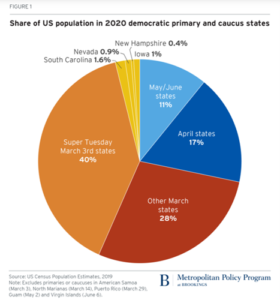
The chart from the Brookings Institution above show how many US voters had no say in the nomination process. The votes of those in any of the states which held their primaries after March were effectively irrelevant.
Moreover, the primary system gives far too much influence to front running states such as Iowa and New Hampshire. This is problematic because Iowa and New Hampshire have whiter, more rural populations and therefore don’t represent the views of the America as a whole. Given that it is uncommon for candidates to win the nomination after poor performances in these two states, candidates who appeal to the populations of Iowa and New Hampshire have an outsized advantage.
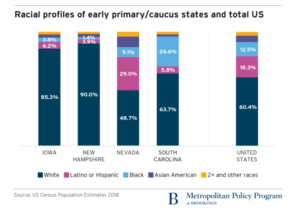
Iowa and New Hampshire are not demographically representitive of America, being considerably whiter than the country as a whole. Given the momentum that candidates who win in Iowa and New Hampshire generate, do we get candiddates who America as a whole can get behind? – Chart from the Brookings Institution.
This was the case for the favourite to win the Democratic Party nomination in 2008, Hillary Clinton. Her third-place finish in Iowa cast serious doubts over her candidacy and she subsequently failed to regain the momentum. On the other hand, it could be argued that this system works much more effectively that having one single day of voting as it tests the candidate’s stamina by forcing them to campaign over a series of months right across the country. For example, in the first months of 2020, Joe Biden was able to dispel questions over his age and health by doing just that. Moreover, it could be argued that the inclusion of Super Tuesday relatively early in the primary program provides candidates with something close to a national day of voting by allowing 12-15 states to vote all on the same day. Despite complaints, giving Iowa and New Hampshire the opportunity to vote first in the primary campaign is only a minor issue. In 2020, Joe Biden proved that a strong performance in Iowa and New Hampshire was unimportant given that he finished 4th and 5th in the two states respectively. Biden was confident that the considerable black population in South Carolina would vote for him in the 4th primary and provide the shot in the arm his campaign needed. This was duly the case and Biden then won 10 of the 14 states which voted on Super Tuesday thereby effectively guaranteeing him the nomination. Nonetheless, Biden’s performance in 2020 is the anomaly. For a candidate to win the nomination is likely that they will need to win or at least show a strong performance in Iowa and New Hampshire.
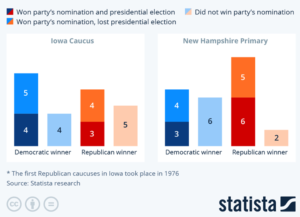
Winning Iowa and New Hampshire is not critical for winning the nomination. However, 9 of the last 13 Democrats to win in Iowa have gone on to win their party’s nomination whilst 7 of the last 12 Republican nominees have done so. Thanks to Statista for the graph.
Given that both states, and particularly Iowa with its caucus, tends to favour more ideological extreme candidates, it is clear that staggering the primaries over a number of months rather then holding a national day of voting is leading to a poorer choice of candidates in Presidential elections.
One of the biggest issues associated with the primaries is that only candidates with significant fundraising abilities can have a hope of winning. In 2020, once favoured candidates such as Kamala Harris and Cory Booker had to withdraw from the race to the be the Democrat nominee because they ran out of money. Moreover, this means that too often, candidates are too reliant on the funding of big corporations or wealthy donors, giving too much power to a small number of wealthy individuals, whose donations can determine who becomes each party’s nominee. Nevertheless, an endless supply of money does not necessarily guarantee victory for Presidential candidates. For example, Mike Bloomberg spent over $200million in trying to win the Democratic Party nomination in 2020 only to fail massively, winning just the vote of American Samoa. The demand for considerable fundraising might also be seen as a positive quality however. In 2008, Barack Obama was able to win the Democratic nomination by amassing a war chest mostly derived from small donations. Obama’s fundraising ability demonstrated that he had the support of hundreds of thousands of ordinary Americans who were willing to donate small sums to his campaign, thus proving his strength as a candidate in the eyes of many. On balance, it is fair to say that candidates for the Presidency such as Joe Biden, Hillary Clinton and Donald Trump are less reliant on fundraising because of they already held considerable name recognition prior to the contest. Lesser known candidates such as Harris and Booker were reliant on money to fund the advertisements needed to present themselves to the electorate. Therefore, it could be argued that the need for large sums of money during the primary campaign may not be decisive in determining who will win, but it does have the impact of preventing lesser known candidates from gaining momentum and the name recognition needed to launch a successful campaign and thereby reduces to the pool of prospective candidates.
