Unit 1 – Democracy and Participation: Is there a participation crisis in UK politics?
This is a potential unit 1 question. There might be different ways in which it could be asked. For example, ‘should the UK make voting compulsory?’
Introduction – define the issue and explain how people participate in politics in the UK.
What does the question mean?
It is often argued that Britain suffers, and has long suffered, from a participation crisis. However, it can equally be argued that the growth of pressure groups, direct action and online activism counters the idea that Britain does indeed suffer from a participation crisis. So, what might be the arguments for and against the notion that Britain does suffer from a ‘participation crisis’?
What is meant by a ‘participation crisis’?
Political participation refers to any action taken to influence the political system. It is an essential part of a functioning democracy. Higher levels of participation increase the legitimacy of political action, the mandate of politicians and governments and the understanding of the political process.
The term ‘participation crisis’ refers to the idea that participation in the political process is so low that it is undermining the legitimacy and strength of the democratic system.
What is political participation?
The most obvious evidence of participation is the political process is voting in elections and referendums. However, other potential examples of participation might include:
- Membership of a political party
- Being a member of a pressure group
- Being a member of a trade union
- Engaging in political activism
Point 1 – There is a participation crisis because Voting Turnout has trended downwards since 1997

The low point was reached in 2001 when just 59.4% of voters turned out in the General Election. This election saw Labour win a majority of 166 seats. However, they did so with just 40.7% of the vote. Since this point, turnouts have increased, but they had not returned to the situations in the 1950s and 1960s where three-quarters of more of voters regularly turned out.
In addition, it is not just General Elections in which turnout is low and for some types of elections it even lower. The turnout was just 33.6% in the 2022 Local Elections, although turnout at Local Elections is higher when they correspond with a General Election. For example, the turnout in the 2015 Local Elections was 65%.
Turnout in for elections to devolved institutions has also not been as high as they could have been. In the last set of elections for each institution turnout was:
- Welsh Parliament 2021 – 46.6%
- Scottish Parliament 2021 – 63.5%
- Northern Irish Assembly 2022 – 63.6%
- London Assembly 2021 – 42.7%

However, voting turnout can be significant in certain ballots and is rising in General Elections
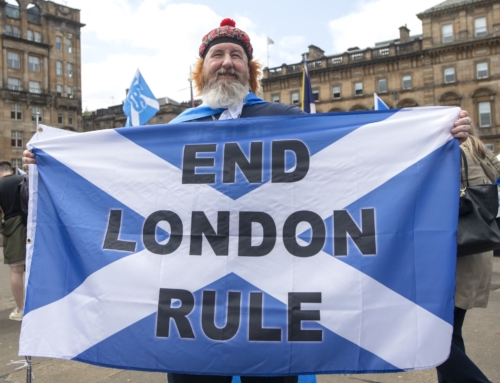
Whilst election turnout has dropped, there have been significant turnouts in other ballots. This is particularly the case in referendums. Notably, the EU Referendum (2016) had a turnout of 72% whilst the Scottish Independence Referendum (2014) had a turnout of 84%. This made it the largest ever democratic exercise in British history. Given the equality of votes that exist for referendums compared to General Elections, this may suggest that turnout is higher when voters feel they are being questioned on a particular issue and where they feel their vote will count towards the result.
In addition, whilst turnout is not as high as it has historically been, it is back on an upwards trend. Turnout in 2017 and 2019 was stronger (68.8% and 67.3%). Nonetheless, in 2024, turnout was just 59.7%. This can be attributed to the nature of the election, which many regarded as a foregone conclusion. For others, there was genuine apathy amongst the electorate, with little appetite for either of the main political parties.
On balance, I would argue that the strongest argument is that the low turnout in General Elections demonstrates a participation crisis. Whilst turnout is not the only metric for participation, it is an absolutely essential one. A functioning democracy relies on people being willing to cast their vote and it would be preferable if this was happening in greater numbers in the UK.
Membership of political parties has declined significantly
The memberships of political parties has declined significantly over time. The most recent estimates suggest that Labour is the biggest party with 432k members with the Conservatives second with 172k members. It should be noted that a proportion of citizens, the SNP have the highest membership with 2.5% of all Scots. Whilst these are not necessarily small numbers, they pale into insignificance compared to what has been seen historically. The highest historic membership numbers were in 1953 (2.8 million for the Conservatives and 1.0 million for Labour). Traditionally party membership was absolutely essential in political participation and attending local party meetings was a common occurrence. Recently, membership of political parties has declined. This may be partially due to a divergence in the way that people engage with Politics. However, there can also be no doubt that the growing levels of mistrust have had an impact on party membership. The Iraq War, MPs Expenses, Brexit Process, Partygate – a series of scandals has harmed trust in Politics and it is difficult to see how it will recover.

Graph courtsey of statista
On the other hand, we should acknowledge that membership of political parties can grow quickly. Labour’s experience under Jeremy Corbyn shows how quickly party membership can grow in the right circumstances. When Corbyn became leader of the Labour Party in 2015 this energised many people and the party almost doubled in size. Whilst those numbers have dropped since 2019, they have not dropped to their previous levels. Similarly, the Reform Party claim to have over taken the membership numbers of the Conservative Party, despite only recently making a political breakthrough as the 2024 election.
Trade Union Membership has decreased significantly
Traditionally one of the ways that people were most likely to engage in politics was via Trade Unions. At their height in the 1970s, there were 13 million Britons who were members of Trade Unions. However, Thatcherism in the 1980s saw the state take on the power and influence of the trade unions, most famously in the miner’s strike of 1984-85. The Government under Thatcher passed legislation that limited the power of trade unions. Notably, the Employment Act of 1980 limited sympathy picketing and the Employment Act of 1982 limited the operation of closed shops (whereby employers could only hire union members). When New Labour were in power the traditional rights of trade unions were not restored and through the Trade Union Act (2016) the Conservative Government was made it even harder for unions to take strike action. By 2000 the the number of trade unions members had dropped to 7.3 million. In 2019 it stood at 6.44 million (23.5%) of the population. Whilst Trade Unions are most associated with strikes, they perform important functions beyond that, helping workers to engage with the political process and unions can perform and important educative function. Nevertheless, Trade Unions have seen a re-emergence recently. The years 2022 and 2023 have seen comparisons with the 1970s in terms of industrial disputes. The number of strike days has grown significantly. Between May and October 2022 1.2 million working days were lost to strike action. In addition, 2023 has saw significant strike action with strikes taking place in transport, schools, post services and the NHS, amongst others. Membership of trade unions has also been on the rise. For example, since the National Education Balloted for strike action in January 2023 its membership has grown by 44,000. The success of many trade unions in negotiating improved pay and conditions for their members has awoken many to older ways of political participation. On balance the strongest argument is that trade union membership represents only a tiny fraction of the population. Membership of trade unions may have increased in recent years, but it is still far below what it once was and given that most workers now exist in un unionised industries, we can be fairly certain that the rise in trade union membership will soon plateau.
Other points that could be made:
Participation is changing, not declining
The internet has utterly transformed communication in the UK and this includes how people may participate in Politics. The internet allows people to partake in political debate from their sofas. Whilst much of this debate may be passive, it is happening in such significant numbers to make it a notable area of participation. The use of E-Petitions is a visible example of the power of the internet to make political opinion heard. Since their introduction that have been a number of significant E-Petitions on the Government Website:
- Revoke Article 50 and Remain in the EU – 6.1 Million (2019)
- Prevent Donald Trump from making a State Visit to the United Kingdom – 1.8 Million (2017)
- End child food poverty – 1.1 Million (2020)
Whilst these individual petitions may not have forced change, they undoubtedly influenced the narrative. For example, the End Child Food Poverty agenda was taken forward by the Labour Party and led to policy changes. The internet has allowed ideas to spread more quickly and thus political pressure to be bought on politicians. The #metoo movement and the Black Lives Matter movement were both driven by the internet. It can therefore very much be argued that participation has not really declined, it has simply moved online.
Pressure Groups are of significant size
Whilst membership of political parties is declining, membership of pressure groups has increased. Some of these groups are truly mass movements. For example, environmental groups have a membership of around 4.5 million in the UK, meaning around 1 in 10 adults are members of such groups. Whilst political parties are focused on appealing to people on a range of issues, Pressure Groups tend to focus on a narrower set of issues which truly unite its membership. In a time when people feel disconnected with politicians, they may feel that pressure groups are a way that enable them to have an impact on government decisions . This is particularly the case through membership of insider pressure groups that have the ear of the government.
There has been a growth in direct action
There has also been a growth in direct action in recent years. Groups such as Just Stop Oil and Extinction Rebellion have seen direct action as a method to bring attention to the issues that matter to them. During 2022, for example, Just Stop Oil actions included the following:
1 – Vandalism Artwork
2 – Blocking Roads
3 – Scaling Bridges
4 – Spray Painting Buildings
Whilst such actions are unlawful, this very fact shows the degree of commitment within the participation that is taking place.
Summary
When looking at this topic it can be far too easy to focus disproportionately on turnout. Whilst this is an essential topic for this question, it is not the only one – and participation more broadly has to be considered. Participation is fundamental to the success of a political system. It is a doubtable statement that there is a ‘participation crisis’ in Britain. However, it might well be argued there is a ‘participation quality crisis’, given the nature of the way participation has changed.